What the teacher editions contain.
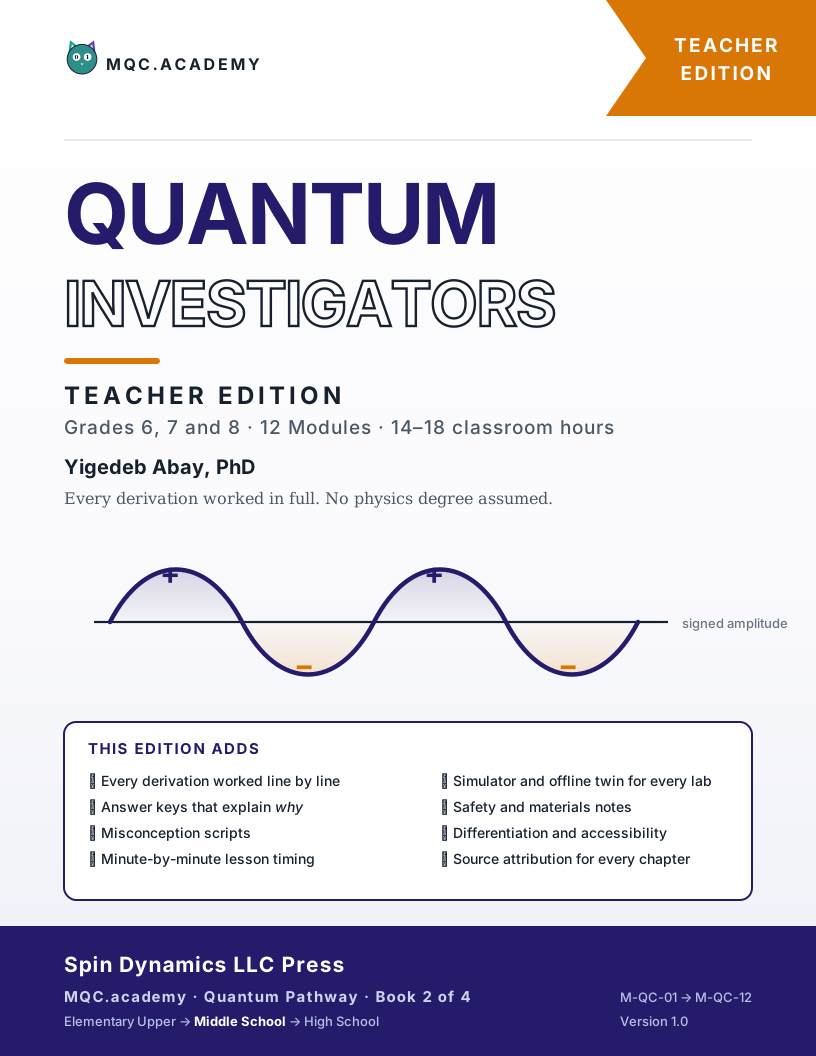
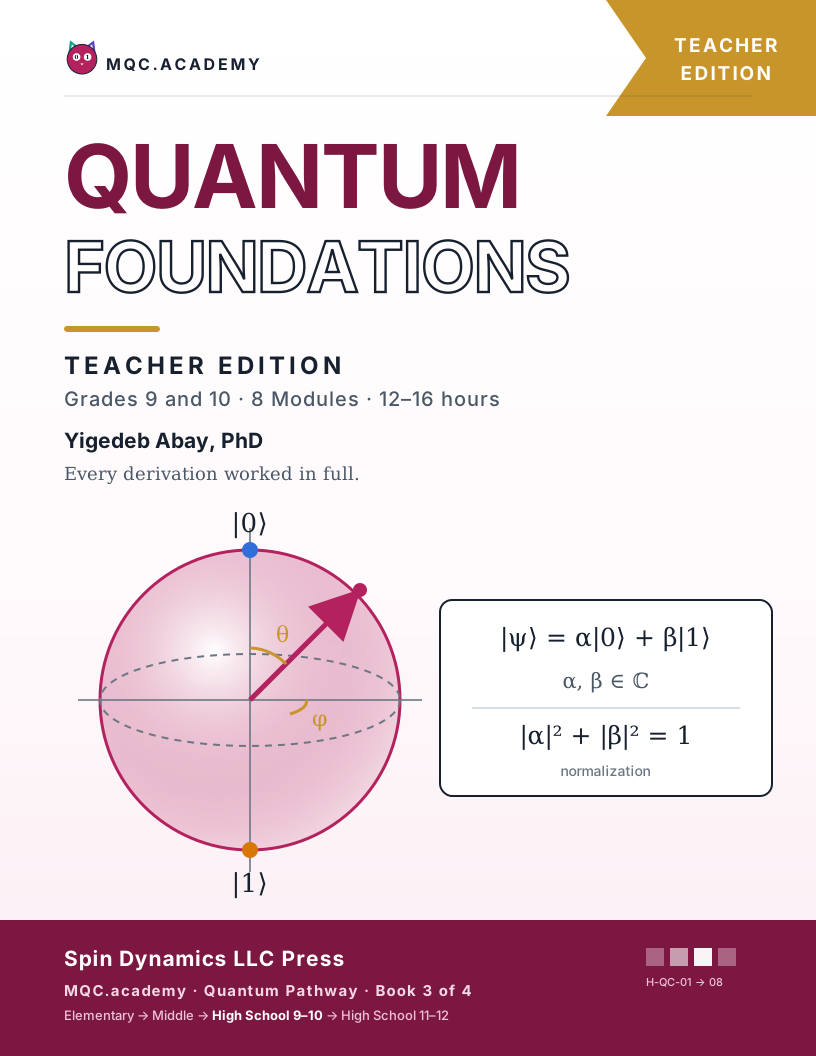
Each teacher edition contains the lesson plans, the materials lists, the answer keys, and notes on the misconceptions students commonly bring, written for teachers without a physics background.
Ten pieces, the same in all 42 modules.
Lesson plan
Minute-by-minute, with the prediction step marked so it is never skipped.
Facilitation guide
What to say, what to ask, and when to stay quiet and let the experiment speak.
Student pages
Handouts and workbook pages, printable and photocopiable.
Slide deck
Highly visual, little text, with speaker notes for the teacher.
Activity or lab
Ordinary classroom materials. A printable alternative to every simulator.
Formative assessment
Exit tickets and quizzes that test the objective rather than reading ability.
Answer key
Answers that explain why, including the common wrong answers and what they reveal.
Vocabulary and extensions
Plain-language definitions, optional challenges for advanced students, and source notes.
The complete student book, plus the panel after every chapter.
You never flip between two books. Each teacher edition reproduces the student text in full and inserts a teacher panel after each chapter. The back matter adds the diagnostic pre-check, a standards summary and the accuracy policy.
- Misconception scripts: what students will say, and the reply
- Safety and materials notes for every activity
- Differentiation and accessibility options
- Source attribution identifying which lecture or chapter informed each lesson
- Pacing for block and traditional schedules
Request a teacher edition: info@mqc.academy
See the books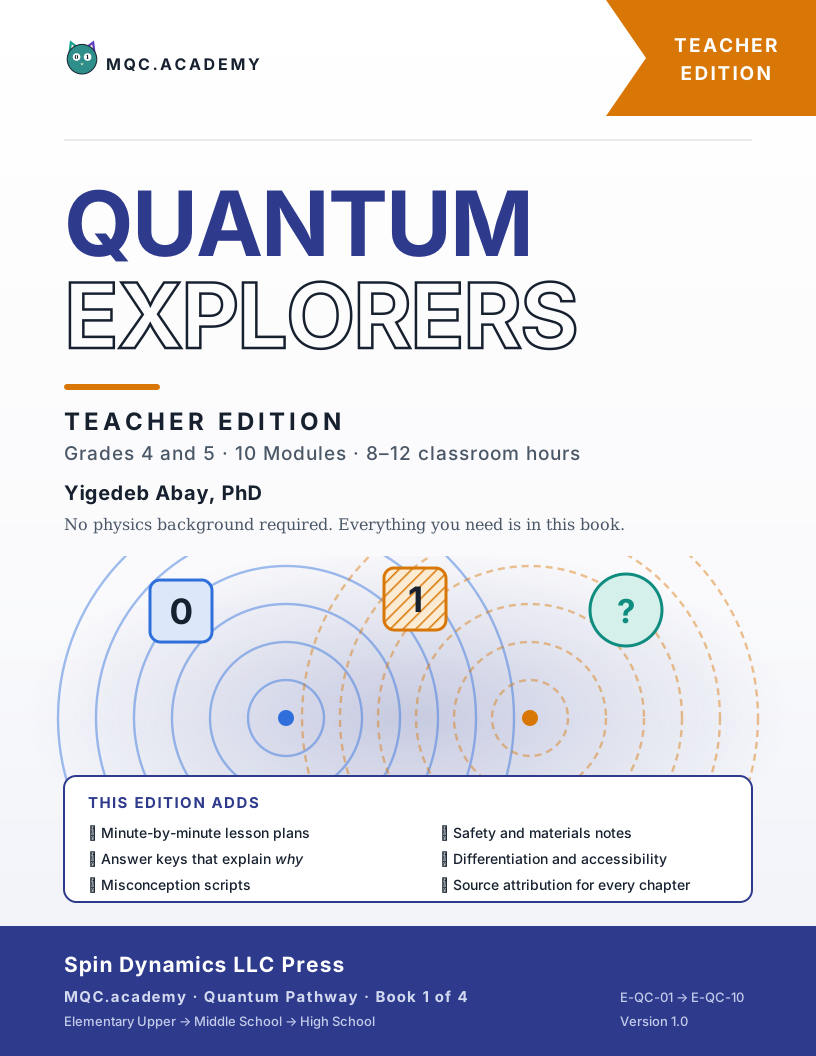
Five instruments per band.
Assessment rewards reasoning, not only correct answers. Students should always know where they are, what they learned, what comes next, and what they need to retry.
Diagnostic pre-check
Before the band starts: what students already believe.
Exit tickets
One per lesson, two to three minutes.
Module quizzes
Short, objective-linked, with an answer key.
Performance task and capstone
A rubric-scored project that closes each band.
What you need on the first day.
Grades 4–5
Index cards, dice, coins, a ripple tray or shallow pan of water, rope, transparency sheets. A projector for the slides. No computers required.
Grades 6–8
Everything above, plus polarizing filters and shared access to a web-based circuit simulator for the later modules. Printable alternatives are included.
Grades 9–12
Scientific calculators or a spreadsheet, a circuit simulator, and for the optional Grades 11–12 coding labs, a computer with a browser. Open-source frameworks are optional, never required.
Safety: demonstrations are low-risk by design. No lasers directed at eyes, no high voltage, no radioactive sources, no unsupervised electrical disassembly.
Review copies
Write to us to request a review copy of any teacher edition.