For students

What students do in this program.

The lessons start from things students have already seen: narrowing down a guess with yes/no questions, ripples crossing in a puddle, dice rolls evening out over many tries. Each module builds from one of those toward a quantum idea and its name.

What a lesson is like

You predict first. Then you find out.

Nobody tells you the answer up front. Every lesson starts with a question, you commit to a guess, and then an experiment or simulation shows what really happens. The explanation comes after you want it.

Ask

A question you can already half-answer, like "How can just two symbols hold any message?"

Predict

Write down what you think will happen. Being wrong here is useful, and expected.

Try it

Cards, dice, rope waves, polarizing filters, or a circuit simulator. The materials are ordinary classroom items or a free web simulator.

Explain

Now the idea gets its real name, and you use it on a new problem before the lesson ends.

Find your level

What you will do, and what you will be able to explain.

You can start at any band. Each book begins by telling you what the earlier level covered, so you are never lost.

Grades 4–5

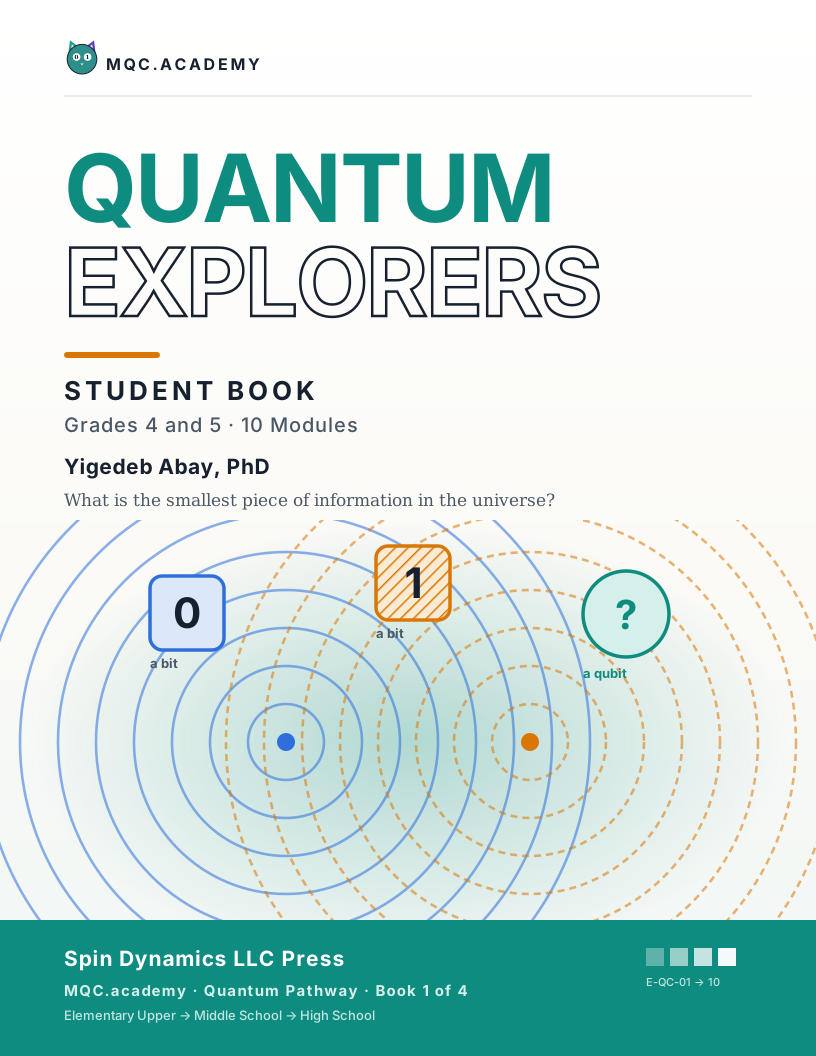
Quantum Explorers

10 modules

You will: become the bits in a human binary code, make waves add up and cancel, roll dice to see why scientists repeat experiments, and play a game that shows how to catch an eavesdropper.

You will be able to explain: what a bit is, what a qubit is, why measuring gives one result, and why "the cat is alive and dead at once" is not what science says.
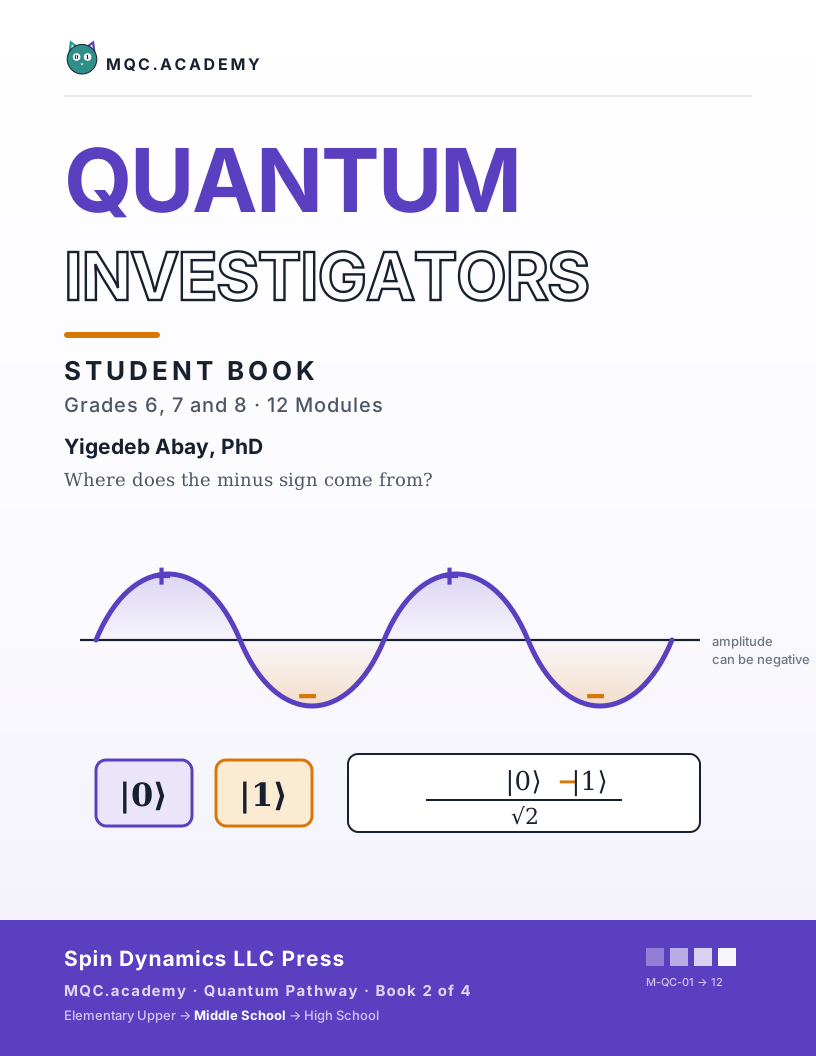
Grades 6–8

Quantum Investigators

12 modules

You will: write states as |0⟩ and |1⟩, work out probabilities from amplitudes, build small circuits on paper and then run them in a simulator, and walk through the BB84 key exchange.

You will be able to explain: why the H gate applied twice gives back what you started with, and why that depends on a minus sign.

Grades 9–10

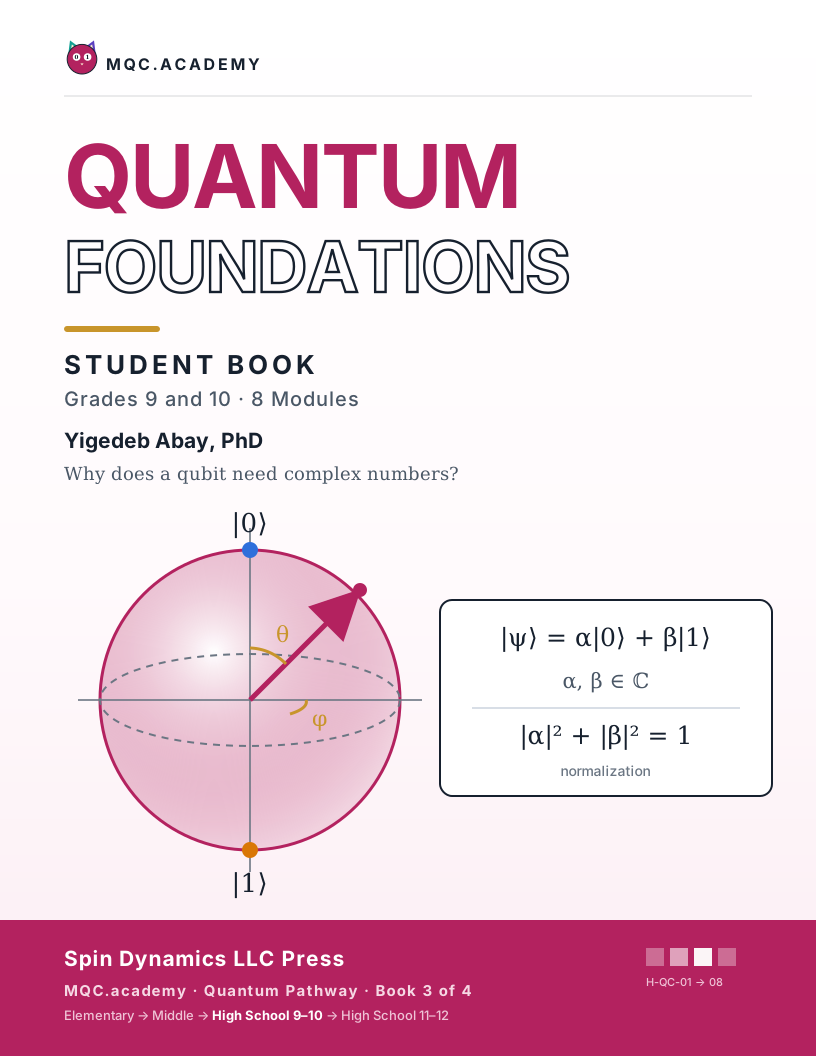
Quantum Foundations

8 modules

You will: use complex numbers, vectors and 2×2 matrices to write a qubit exactly, derive the Born rule, and place any state on the Bloch sphere.

You will be able to explain: what α|0⟩ + β|1⟩ means, why |α|² + |β|² = 1, and what interference has to do with phase.

Grades 11–12

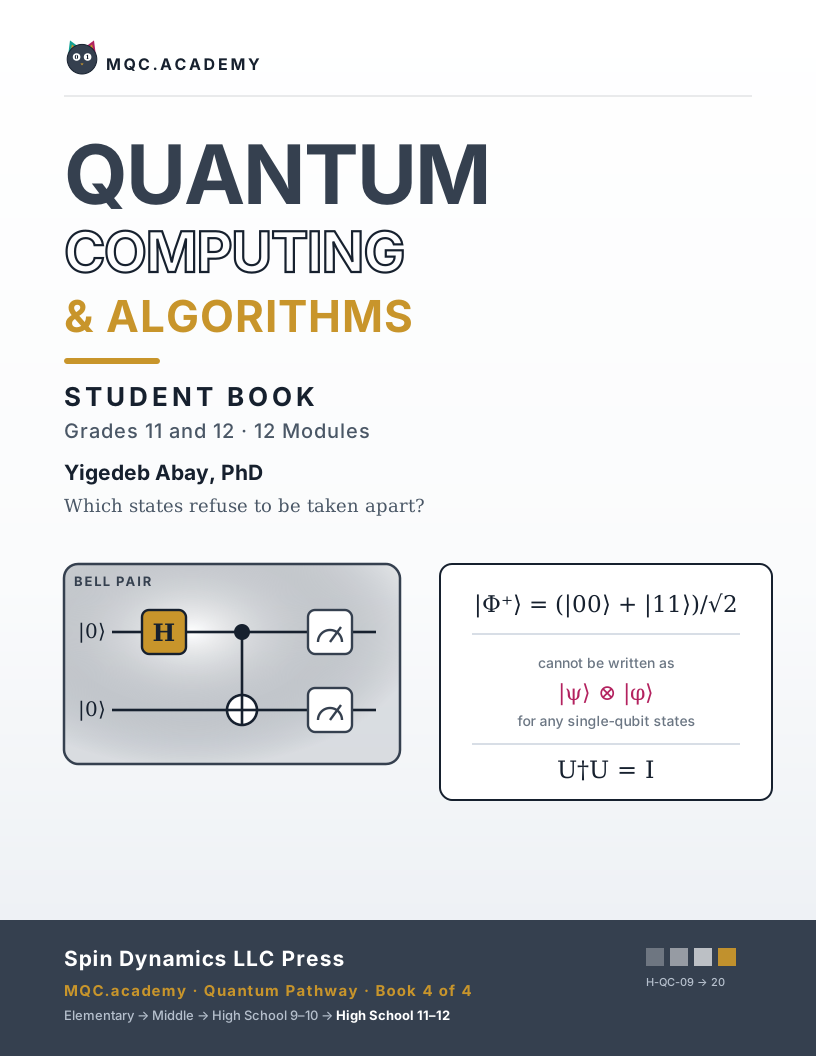
Quantum Computing and Algorithms

12 modules

You will: work with multi-qubit states, prove that gates are unitary, build Bell pairs, trace Deutsch–Jozsa, Grover and Shor, analyze QKD security, and finish with a capstone project.

You will be able to explain: which states cannot be taken apart, what a quantum computer is actually good at, and what it is not.

Inside every chapter

The boxes you will see, and what they are for.

  • Key idea. The one sentence to keep if you keep nothing else.
  • Try it. Do this before reading on. Usually before you have been told the answer.
  • Lab. A real experiment or simulation. Write your prediction down first.
  • Worked example. A full calculation with every step shown. Cover the answer and try it.
  • Myth check. A claim that sounds right, why it is not, and what to say instead.
  • Look closely. Every picture ends with a question about what you can see in it.
Statements we do not teach

Common statements that are not accurate.

These appear often in popular accounts. The books mark each one and give the accurate wording.

  • Not trueA qubit is 0 and 1 at the same time.
    Say insteadA qubit can be in a superposition. Measure it and you get 0 or 1.
  • Not trueEntangled particles send messages instantly.
    Say insteadTheir results are correlated. No message travels.
  • Not trueQuantum computers are faster at everything.
    Say insteadThey help with some specific problems, and not with most others.

Meet Professor Ket

Professor Ket, the MQC.academy cat

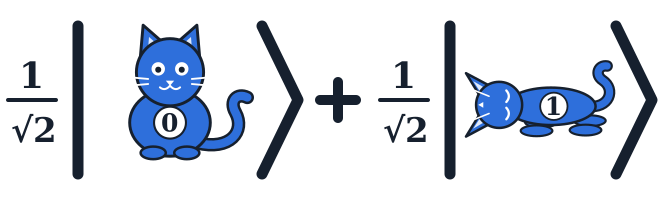
Your guide through every book is a cat named after the ket, |ψ⟩, the symbol for a quantum state. Look at our mark: it is a qubit state, (1/√2)|0⟩ + (1/√2)|1⟩, with one cat drawn twice: sitting up as |0⟩ and lying down as |1⟩. It is the same cat in both kets, because the state belongs to one cat. Grades 6–8 learn to read it. Grades 9–10 learn to calculate with it. Professor Ket is Schrödinger's cat, and Professor Ket's whole job is to show you that the cat is not both.

What you need

For Grades 4–8: pencil, paper, a few index cards and a die. For high school: a scientific calculator and a web browser for the circuit simulator. The optional coding labs in Grades 11–12 use free, open-source tools.

Every simulator activity has a printable version, so you can do the whole program offline.

For parents and guardians

No prior physics is needed at home. Each elementary module takes 45 to 60 minutes and uses ordinary household materials. A useful question to ask at home is "What did you predict, and what actually happened?"

Questions: info@mqc.academy

Contact

Questions from students and families.

Students and families can write to us with questions. Teachers can request a review copy of any book.