Book 1 · Elementary
Quantum Explorers
Grades 4–5
Stories, games, cards, ripple trays and probability experiments. One central idea per lesson; symbols arrive only after the idea is already understood.
Four student books, four teacher editions, 42 modules and 42 slide decks, adapted from a graduate quantum computing course. Each grade band teaches the same ideas at its own level of mathematics.
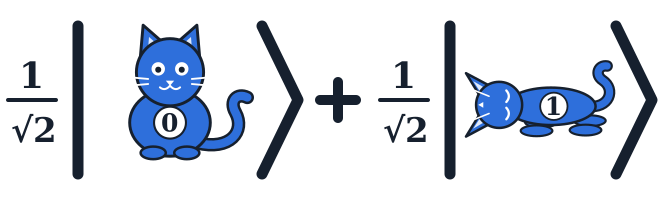
Our narrator is Professor Ket, Schrödinger's cat. Schrödinger invented the cat in 1935 to argue that "alive and dead at once" is absurd, and we teach it that way. The cat is not both. Let's find out what really happens.
Four design rules apply to every module.
Each band is a different learning experience. Grades 4–5 use cards, dice and ripple trays. Grades 11–12 prove that U†U = I. The same ideas, taught four ways.
No book says a qubit is "0 and 1 at the same time," that entanglement sends messages, or that quantum computers are faster at everything. Every myth gets a correction box instead.
Every lesson follows hook, predict, experiment, observe, explain, check, apply, reflect. Students commit to a prediction out loud before the evidence arrives.
Written for teachers without a physics background. Teacher editions carry minute-by-minute plans, answer keys that explain why, misconception scripts, safety notes and source attribution.
Students can enter at any band. Each book opens by naming what the previous level gave them and what this level will do with it.
Stories, games, cards, ripple trays and probability experiments. One central idea per lesson; symbols arrive only after the idea is already understood.
Binary numbers, vectors as arrows, simple probability and visual circuits. Students meet |0⟩, |1⟩ and 1/√2, and predict circuit outcomes before running simulators.
Complex numbers, vectors and matrices, the Born rule, the Bloch sphere. The state vector written exactly, with every step derived rather than asserted.
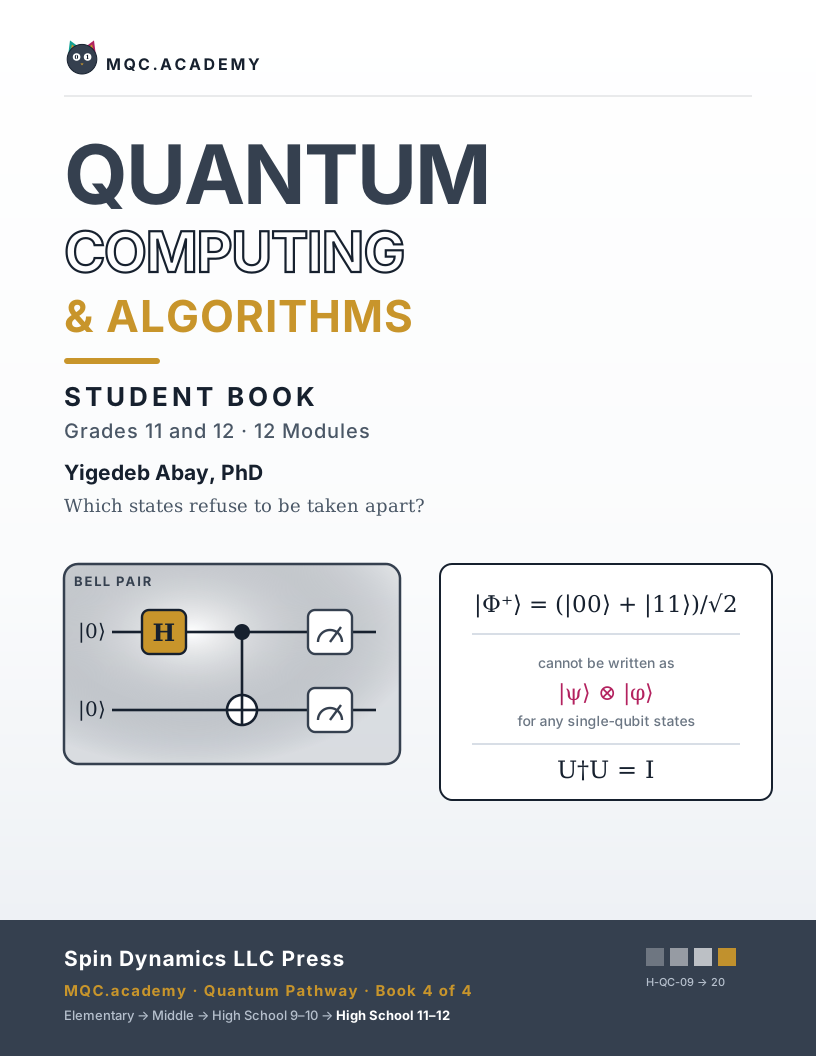
Tensor products, entanglement, unitarity, circuits, Deutsch–Jozsa, Grover, Shor, QKD, error correction, and a capstone. Reads like a first university text.
The one thing a student carries unchanged from Grade 4 to Grade 12: zero is always blue, one is always amber. Everything else grows.
| Concept | Elementary | Middle school | High school |
|---|---|---|---|
| Bits | switches and cards | binary arithmetic | state vectors |
| Superposition | a possibility game | amplitudes and probability | normalized complex amplitudes |
| Measurement | observe one result | repeated trials | Born-rule calculations |
| Spin | two-way detector story | Stern–Gerlach model | basis states and operators |
| Entanglement | correlated-pair puzzle | Bell-state intuition | separability and Bell states |
| Gates | state-change cards | X, H and CNOT circuits | unitary matrices |
| Quantum key distribution | eavesdropper game | BB84 flow | basis analysis and security assumptions |
The explanation comes after the prediction and the experiment. Eight steps, the same in every module and every band.
A question students already half-know how to answer.
Everyone commits to a prediction, out loud or on paper.
A hands-on activity or a simulation with ordinary materials.
Record what actually happened, including the surprises.
Now the idea gets its real name and its real rule.
A short formative check that tests the objective, not reading ability.
The same idea in a new scenario.
What changed in your thinking, and what still puzzles you.
Popular shortcuts are recorded in a myth table in every capstone chapter, each with the wording we use instead.
Each band has a student book and a teacher edition that contains the complete student text plus a teacher panel after every chapter. Review copies are available to teachers and schools on request.
Write to us to request a review copy of any book.